


Condition Survey Series: Lath and Plaster Ceiling Inspections
Our chartered building surveyors provide condition surveys for commercial properties across the country.
Here, we carried out a condition surveys examining lath and plaster ceilings in a series of schools.
Condition surveys to assess ceiling risk
Our chartered surveyors were instructed to carry out a series of building condition surveys of schools in the South-East of England.
Our condition surveys often cover entire properties; in other cicumstances, such as this one, they focus on a particular element or defect.
This case study covers a series of inspections focussed on the ceilings of several school estates, with the aim of identifying where lath and plaster ceilings were present, assessing any defects or issues with the ceilings, and advising on any remedial measures required.
Lath and plaster ceilings and the risk of collapse
Lath and plaster was commonly used from the 1700s right up until the mid-20th Century. It is a plastering technique that involves wooden strips being nailed to a surface and then covered with plaster.
Lath and plaster is vulnerable to cracking and loosening as it ages. Its fragility means that failings can occur, with the risk increasing as the material ages. When lath and plaster is used for ceilings, this presents a risk of collapse and injury to building users if the material is not maintained appropriately.
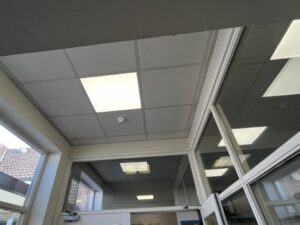
Managing the risk involved with a lath and plaster ceiling can be particularly problematic in commercial and educational buildings because of the use of suspended ceiling tiles in these settings. These tiles stop anyone being able to see the lath and plaster above, and so any damage or deterioration cannot be identified and repaired in a timely manner.
Lath and plaster ceilings in the news
A number of lath and plaster ceiling inspections in schools have been instructed recently, following the partial collapse of a ceiling at a Norfolk primary school. The local authority instigated a series of condition surveys to make sure that their remaining properties were safe and fit for purpose.
A similar incidence was reported in a London shop, where a 100 year old lath and plaster ceiling failed and collapsed following some works being carried about on the floor above.
The most high profile plasterwork collapse was at the the Apollo Theatre in 2013, which resulted in 58 people being taken to hospital. The ceiling was formed of fibrous plasterwork, similar to lath and plaster. This incident highlighted the importance of regularly inspecting and maintaining old plasterwork. This is especially important when the plasterwork forms the ceiling structure, because of the risk of collapse upon failure.
Is my property at risk?
We estimate that there are thousands, of properties across the UK that have heritage plaster ceilings that need regular inspection and maintenance to ensure they remain in good, safe condition.
It is important to remember that there is no inherent risk associated with a lath and plaster ceiling if it is in good condition. However, ignoring warning signs such as cracks, water damage and deterioration can put building occupiers and users at risk.
Several factors can increase the risk of lath and plaster ceiling failure.
- Excess weight from items being stored above or being affixed from beneath.
- Rusting of nails.
- Inadequate maintenance.
- Changes in humidity and temperature.
- Dampness.
- Vibrations.
- Building movement.
- Plaster keys deterioration.
- Poor design in original construction.



Want to know more?
School condition surveys: ceiling inspections
Inspections
- We surveyed the condition of the lath and plaster finishes across a series of schools in the East of England, reporting where areas were damaged or missing plasterwork.
- Given that we were inspecting the entire school buildings, we also included comments on other ceiling types in our report, including suspended mineral fibre ceilings, plasterboard ceilings and concrete ceilings.
- Ceilings were graded using a traffic light system:
- Green: no lath and plaster present
- Amber: lath and plaster present, but no serious issues observed
- Red: lath and plaster present with notable areas of damage or missing sections.
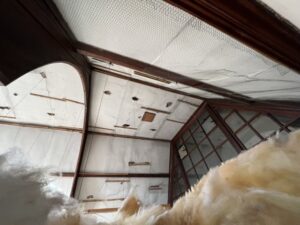
- Inspection was challenging in some areas, because (as with many other schools and commercial buildings), original ceilings were often concealed behind suspended ceiling tiles.
- Fortunately, in most cases we were able to lift tiles at the edges of rooms where insulation was lacking. This allowed us to view and assess small sections of ceilings.
- Areas where previous works had been undertaken were evident.
- In some areas large sections of lath and plaster had been removed, and in others, protective mesh had been installed.
Recommendations
- Widespread replacement of the lath and plaster with new plasterboard would eliminate the risk, however, this would be an expensive process and is not considered necessary, providing that suitable protection measures are supplied and maintained throughout.
- If works are being done to replace lath and plaster, the following should be taken into consideration:
- If the building is listed, consents will also be required to change the type of material used.
- Animal hair was also sometimes incorporated into lath and plaster. This presents a very low, but present, risk of anthrax contamination. It is therefore recommended that precautions are taken when working with historic plaster, such as covering any cuts, washing hands, avoiding contact with the mouth and wearing gloves and dust masks.
- Whilst the mesh wire was found to be providing protection in a number of areas, the condition of this should be regularly inspected and verified to ensure that there are no loose sections and that it is securely fixed.
- This will require the removal of suspended ceilings so that high level access provision can be provided. Whilst there is high level access provision, the opportunity should be taken to remove any loose or bulging sections of the ceiling.
- Additional mesh wire is recommended in areas where this is not present and the surfaces are not visible from ground level, because it is difficult to regularly monitor the condition of the lath and plaster in such circumstances.


Read more about our building condition services.
We're here to help
If you would like to discuss a potential project with our consultants or get advice on any aspect of building surveying or engineering, please don’t hesitate to complete our contact form, call us on 0333 202 6386, or contact one of our regional offices.