


Terminal Dilapidations Negotiation for an Industrial Unit tenant in Northamptonshire
We supported the tenants with dilapidations defence and negotations following a large, £1M claim from their landlord.
Brief: To consider the content of the terminal schedule of dilapidations prepared on behalf of the landlord and to enter into negotiations with the landlord’s surveyor.
Property: Detatched industrial unit near Northampton, comprising offices and a large factory workshop.
Instructed by: Outgoing tenant.

Want to know more?
The Property
- An industrial building constructed with a brick faced two storey office building to the front, connected to a three-section factory which has a brick base with profile sheet on metal framed upper.
- Floor area of approx. 6500 sq. metres.
Initial Dilapidations Review and Defence
- We reviewed the schedule of dilapidations issued by the landlord ahead of lease-end, which included costs totalling over £1 million.
- Our review included relevant lease documents and an inspection of the premises.
- We provide a response in accordance with the current RICS Dilapidations Guidance Note, with comment against the dilapidations items in the form of a Scott Schedule to provide our assessment of the breaches, remedies and quantum claim by the landlord.
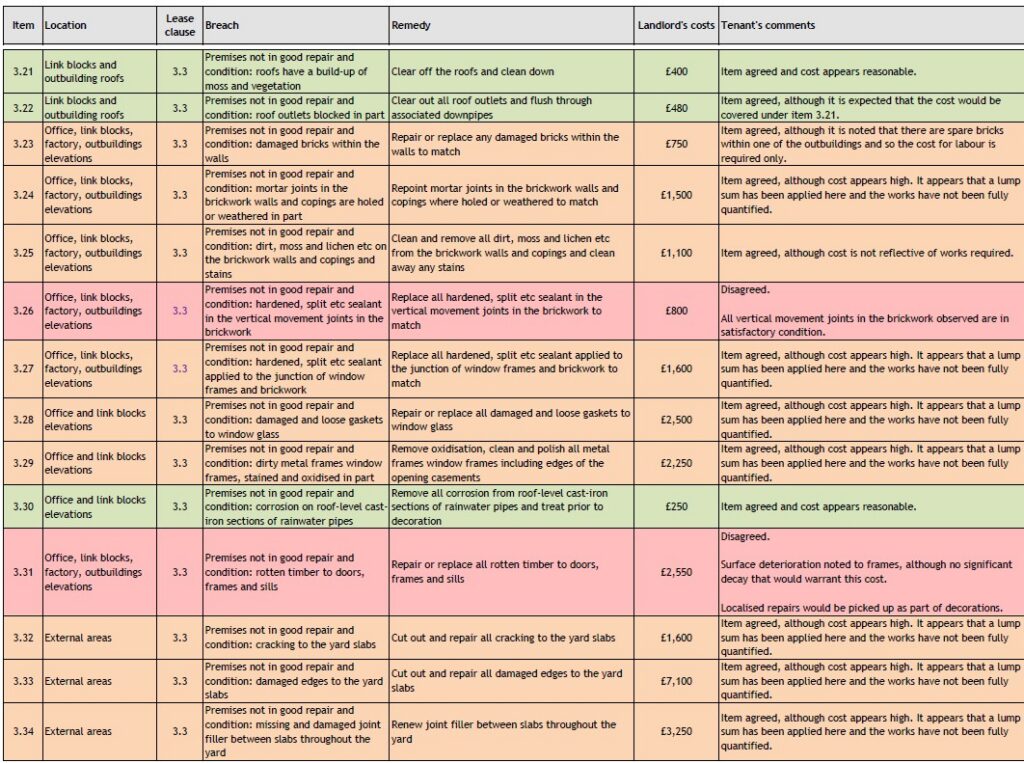
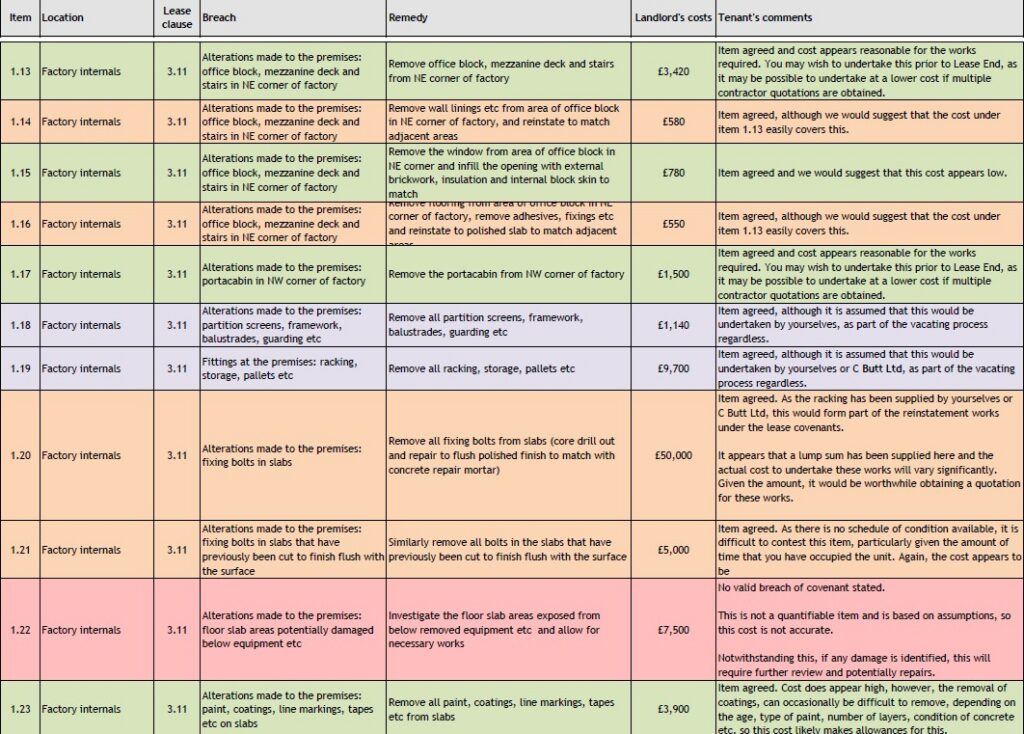
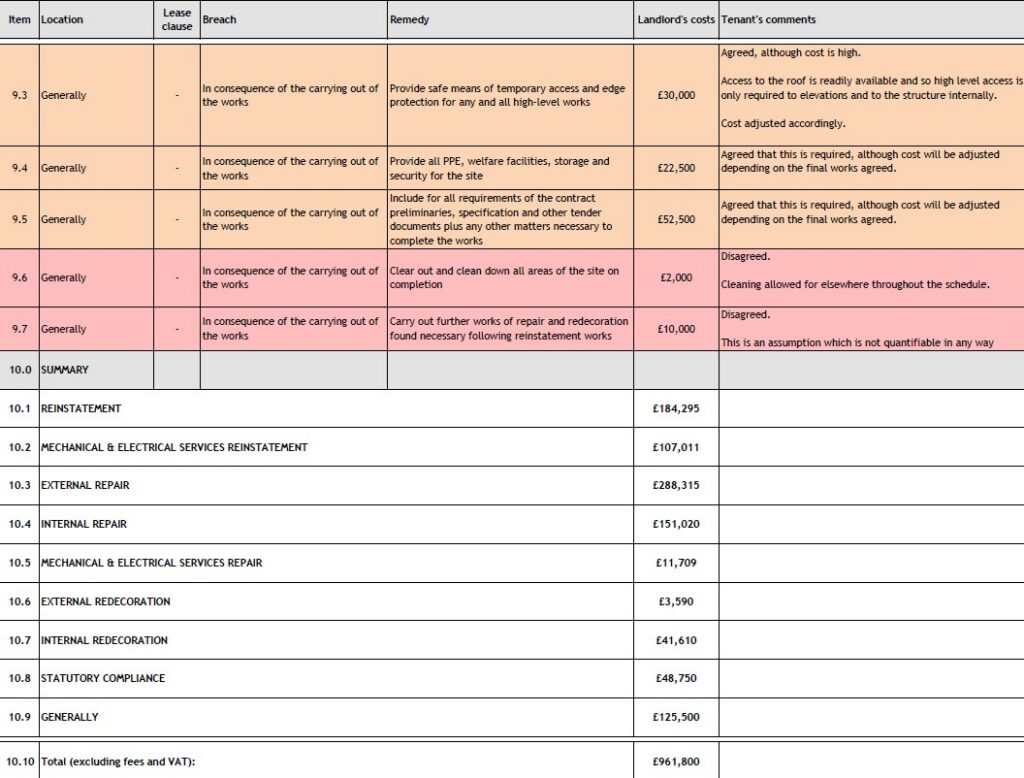
We inspected the property and prepared a colour coded Scott Schedule; a comprehensive document detailing our response to the landlord’s dilapidations claims:
Green – Agree with the item and that there is a breach of covenant. Cost appears reasonable for the works required, albeit tendered rates may differ, as this will come down to the material costs and contractor availability at the time.
Amber – Somewhat agree that there is a breach in covenant, although there are further considerations or the cost does not appear accurate.
Red – Disagree with the item and that there is a breach of covenant. In some cases, this would be subject to further evidence being provided, as the descriptions within the schedule are very vague.
Purple – Items that we consider will be simple for you strip-out, demolish, remove or undertake as part of your vacating process, so will naturally fall away.
While a large proportion of costs appeared very high and could be negotiated, we also found items where costs were lower than we could have expected, or items were lenient and the landlord deemed them as requiring cleaning or minor repairs, whereas we would have anticipated needed to replace them in full.
Lease Considerations
- Following this detailed assessment, we provided our recommendations in respect of the anticipated dilapidations liability, based upon our assessment of the contractual claim, and any potential mitigating arguments.
The situation was more complex than most.
- The lease required the tenant to continue paying a rent-equivalent sum if the property was not handed back in repair.
- This obligation continued until either the tenant’s covenants had been complied with, the landlord could reasonably have completed remedial works, or the property is relet, whichever happened first.
- The tenant was required to pay the landlord’s repair and decoration costs on an indemnity basis if the property was not returned in the required condition. This goes beyond the usual common law position, where damages for disrepair are capped by section 18(1) of the Landlord and Tenant Act 1927 at the amount by which the property’s value has been diminished.
- The clause is unlikely to be struck out as a penalty, since courts generally uphold such agreements where both parties had legal advice, but recovery will still be limited by the Section 18 cap.
The situation was more complex than most.
- The lease required the tenant to continue paying a rent-equivalent sum if the property was not handed back in repair.
This put the landlord in a strong position regarding negotiations. The were likely to have limited incentive to compromise or engage in discussions unless there were very strong counter arguments against the work items on their schedule, because they could fall back on the payments mandated by the lease.
We were also aware that there was no schedule of condition, and so no evidence to argue that finishes were not in good condition at the commencement of the lease.
- The client had expressed an interested in Section 18 Diminution Valuation Survey and Expert Witness CPR 35 report; following our site vist and review of the lease, we advised that this would be a prudent exercise in this case.

Section 18 Diminution Valuation
Whilst usually undertaken at the end of a Lease Term, in this case we advised a Section 18 Diminution Valuation might be a strong argument for use in negotiations.
- While there were several arguments we could use in the early responses back to the Landlord’s surveyor, we were mindful of the specific lease clauses meaning that, on this occasion, the Landlord held the much stronger position in negotiations.
A Section 18 valuation determines the maximum damages that a Landlord can claim by assessing:
The Diminution in Value – It compares the market value of the property in its current ‘disrepaired’ state, with the value if repairing obligations are complied with. The difference between these two figures is the diminution, which caps the Landlord’s claim for damages. This does not relate to reinstatement.
The Alternative Use Test – If the landlord intends to alter, redevelop, or demolish the property after Lease expiry, supersession would apply meaning the tenant’s repairs would be rendered unnecessary and the recoverable damages are reduced or omitted.
- Our Chartered Valuation Surveyor visited the premises himself, to full establish the extent of the dilapidations and the diminution in value.
- He then prepared a thorough, 64-page report on the diminution in value for the premises for the purposes of section 18 of the Landlord and Tenant Act 1927, and whether the damages claimed/claimable for the cost of the works etc by the Claimant Landlord are as much as, more than, or less than the diminution in value figure.
- Overall, considering the need for modernisation and the limited rental potential of such a property, the diminution value was assessed to be just £1500.

Read more about our landlord and tenant dilapidations services here.
We're here to help
If you would like to discuss a potential project with our consultants or get advice on any aspect of building surveying or engineering, please don’t hesitate to complete our contact form, call us on 0333 202 6386, or contact one of our regional offices.
Looking for residential / home survey services?
Looking for a RICS Level 2 or Level 3 Building Survey or Specific Defect Survey for a privately-owned residential property? Our team of residential surveyors and engineers can help. Visit allcottassociates.co.uk or Get an Instant Quote.
Alternatively, Allcott Commercial provides surveying services for housing associations and other residential property owners.